Table of Contents
- Table of Contents
- Overview
- The SDD Plugin I Introduced Last Time
- What SDD Plugin Solved
- The Codebase Grows but the Tool Does Not
- Sessions Were Split but Roles Were Not
- Changing the Angle to Look at People and Organizations
- Guild Plugin Grows Together With the Code
- Building an Agent Organization in the Repo
- The First Growth That Raises the Codebase
- The Second Growth That Raises the Agents
- The Third Axis Is the Person Using the Tool
- Wrapping Up
Overview
Back in April I gave a talk at our internal tech share titled “A Development Process That Uses Generative AI.” I introduced SDD (Spec-Driven Development) as a way to move from human-centered development to AI-centered development, and shared SDD Plugin, the tool I built on top of it.
Four months have passed. In this round’s session I presented the problems I ran into while continuing to use SDD Plugin, and Guild Plugin — the new tool I built to solve them. This article is a write-up of that talk.
There is a separate series that goes much deeper into how Guild Plugin is designed and how it works. This article compresses that material into a single piece, following the flow of the talk.
The source code and installation instructions for Guild Plugin are available in the dev-yakuza/deku-claude-plugins repository.
The SDD Plugin I Introduced Last Time
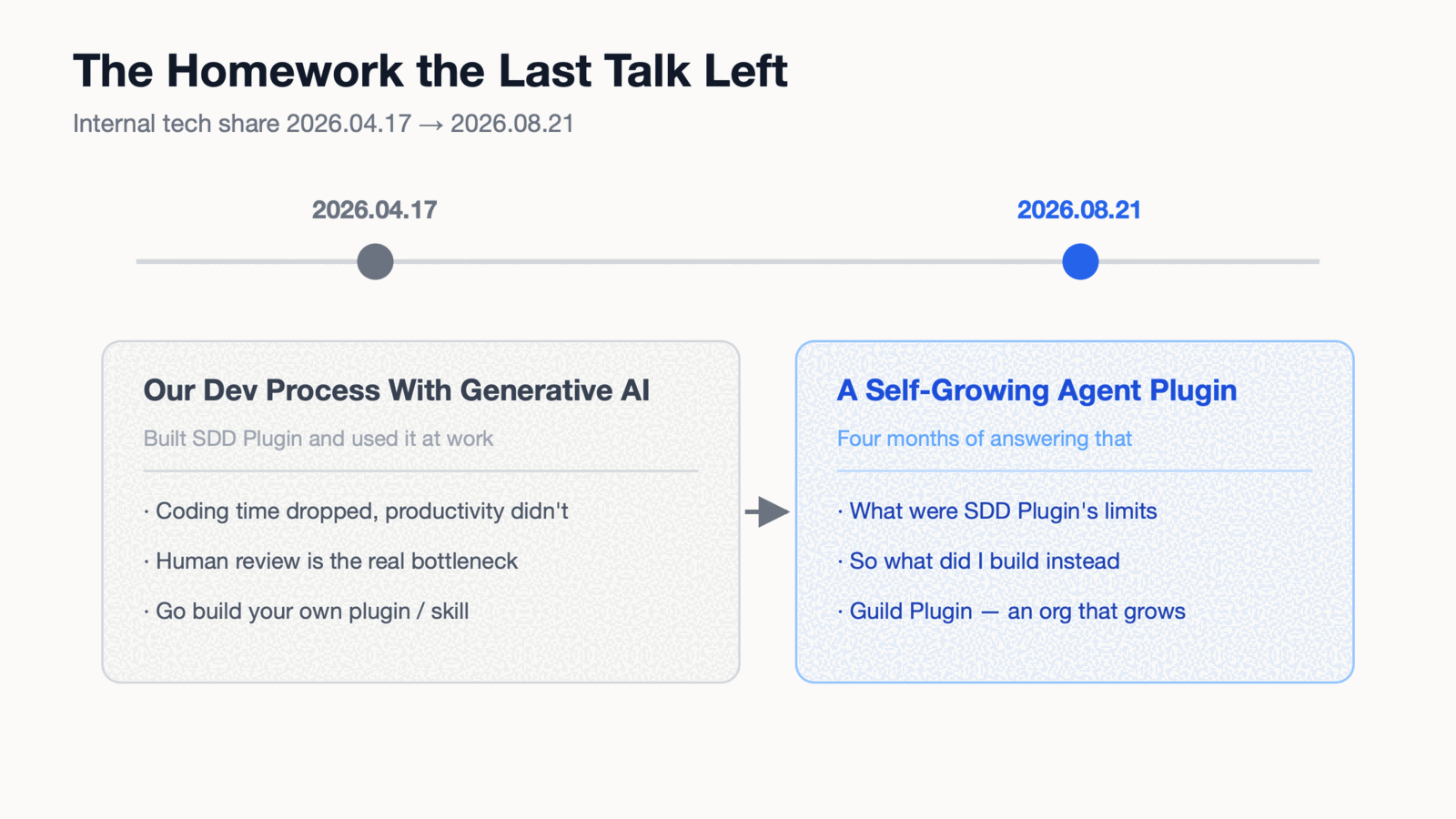
Some people had missed the April talk and quite a bit of time had passed, so I started with a quick recap. SDD Plugin is a plugin that makes Claude walk through a development process — requirements analysis, design, implementation, testing — instead of simply taking a prompt and patching the problem.
That talk ended on three notes.
- Coding time definitely went down. But it never felt like productivity went up.
- Time spent reviewing documents and code went up. It won’t improve much unless human review shrinks.
- Go build your own plugin / skill.
This talk is the four months that followed.
What SDD Plugin Solved
I started with the good parts. AI coding has a few recurring traps.
- Development starts before the task has really been analyzed
- Implementation starts without any design
- Once the conversation (the context) gets long, earlier agreements get forgotten
SDD Plugin made Claude walk the process and record each stage’s output in a GitHub issue, and that solved a good chunk of all three. This part genuinely worked well.
The Codebase Grows but the Tool Does Not
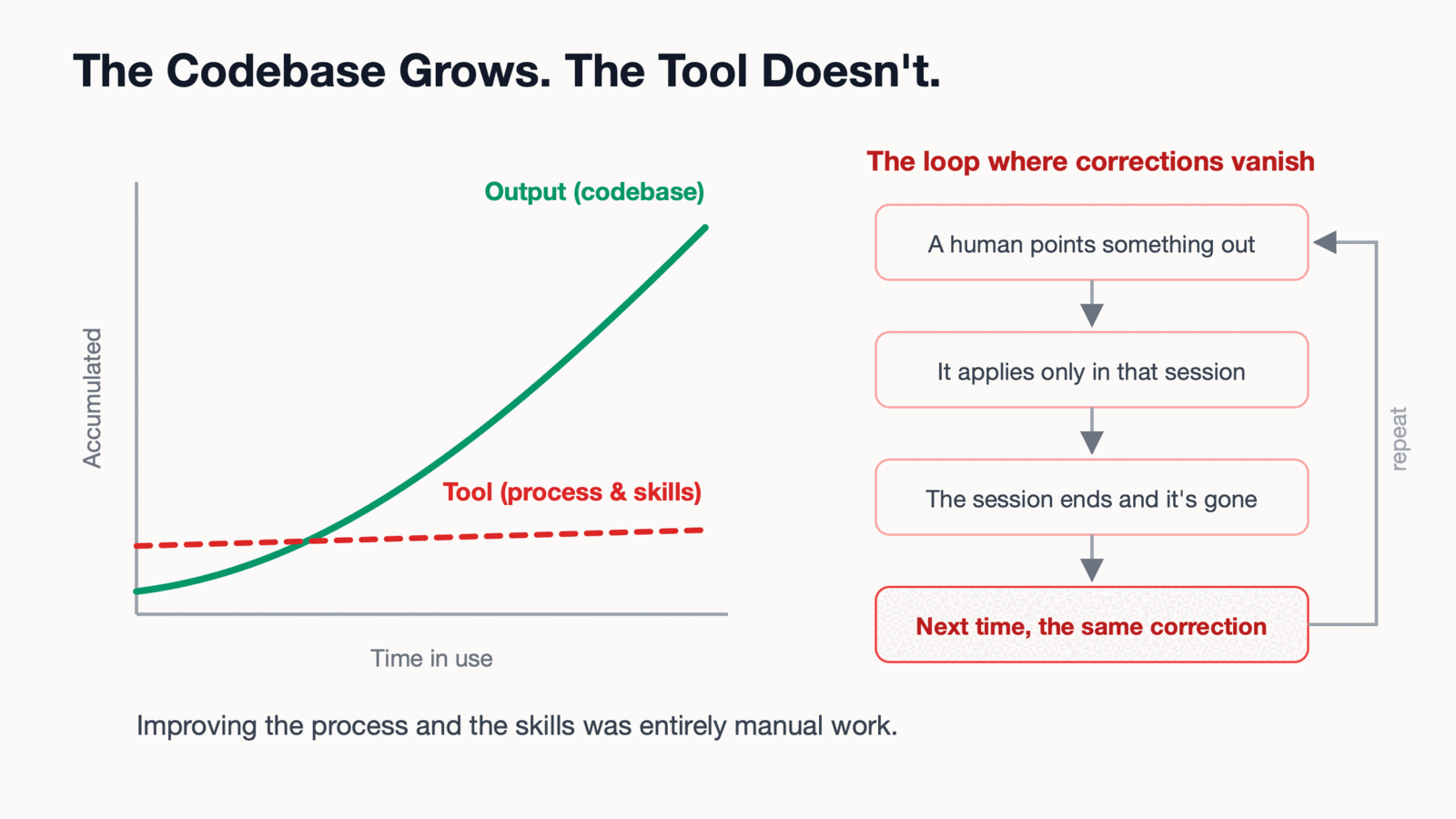
The problem was what came next. The longer I used the plugin, the bigger the codebase got — while the plugin itself stayed exactly as I had first written it.
So I found myself making the same correction over and over. “We don’t use that pattern in this project.” “If you touch this file, you have to touch that one too.” And that correction only lives in that moment. Once the session ends it is gone, and the only way to stop the same problem from coming back was to open the plugin and edit it myself.
Sessions Were Split but Roles Were Not
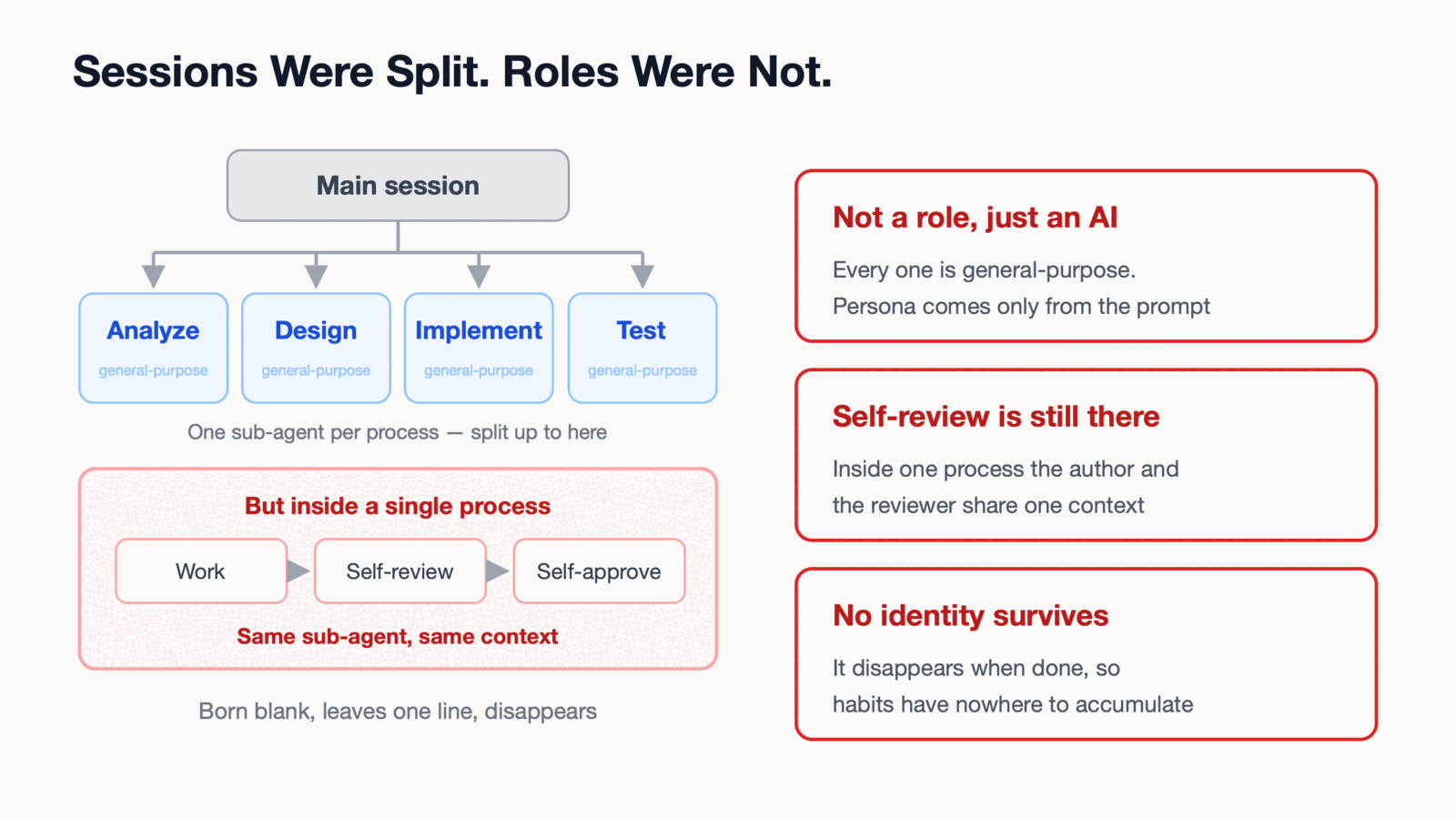
The second problem was structural.
To keep the context from getting polluted, I had it split the session per development process. That part worked. The problem of context piling up endlessly in one window is solved right there.
But those split sessions had no role. They all ran as a generic AI — plain general-purpose. So there was no expertise, and since whatever had just been written was reviewed by the same agent that wrote it, review quality was poor.
To sum up, SDD Plugin had two limits.
- A tool that does not grow
- An executor with no clear role
Changing the Angle to Look at People and Organizations
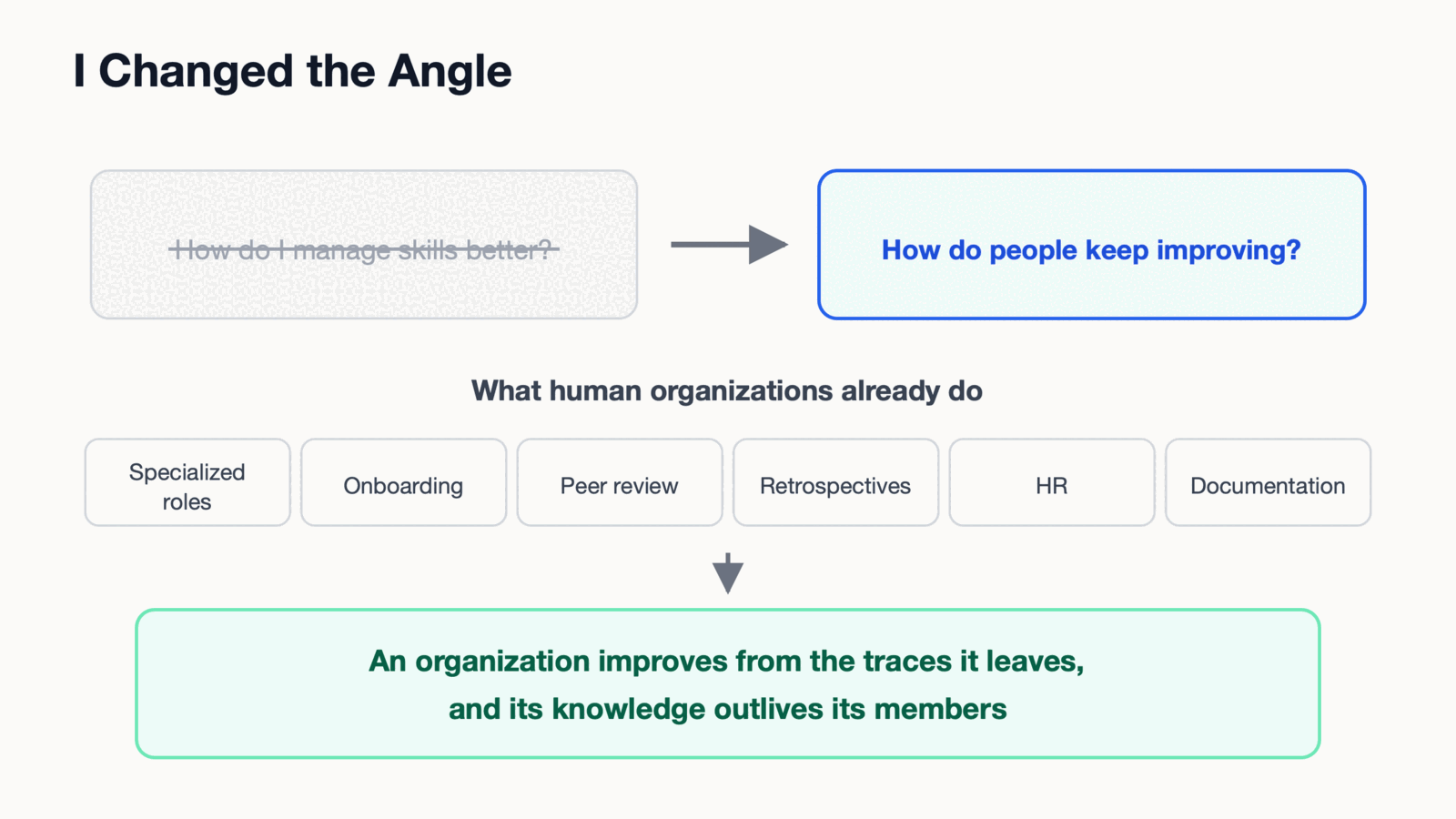
At first I kept asking “how do I manage this plugin, how do I improve it,” and patched SDD Plugin whenever something came up. But at some point it started to feel off. In the end I was only making my own manual labour slightly more efficient.
So I stepped back and changed the angle: how do people, and organizations, actually work?
Look at how a software organization operates.
- There is division of labour and there are specialized roles.
- Code review is done by someone else — obviously.
- To grow, people run retrospectives and get feedback from other members.
- When someone new joins, onboarding shares the knowledge built up so far, and documents are left behind.
- When more people are needed, you hire; and rarely, when it doesn’t work out, you replace.
The thought was: if I imitate people and organizations, maybe I can get more out of AI. That is where Guild Plugin started.
Guild Plugin Grows Together With the Code
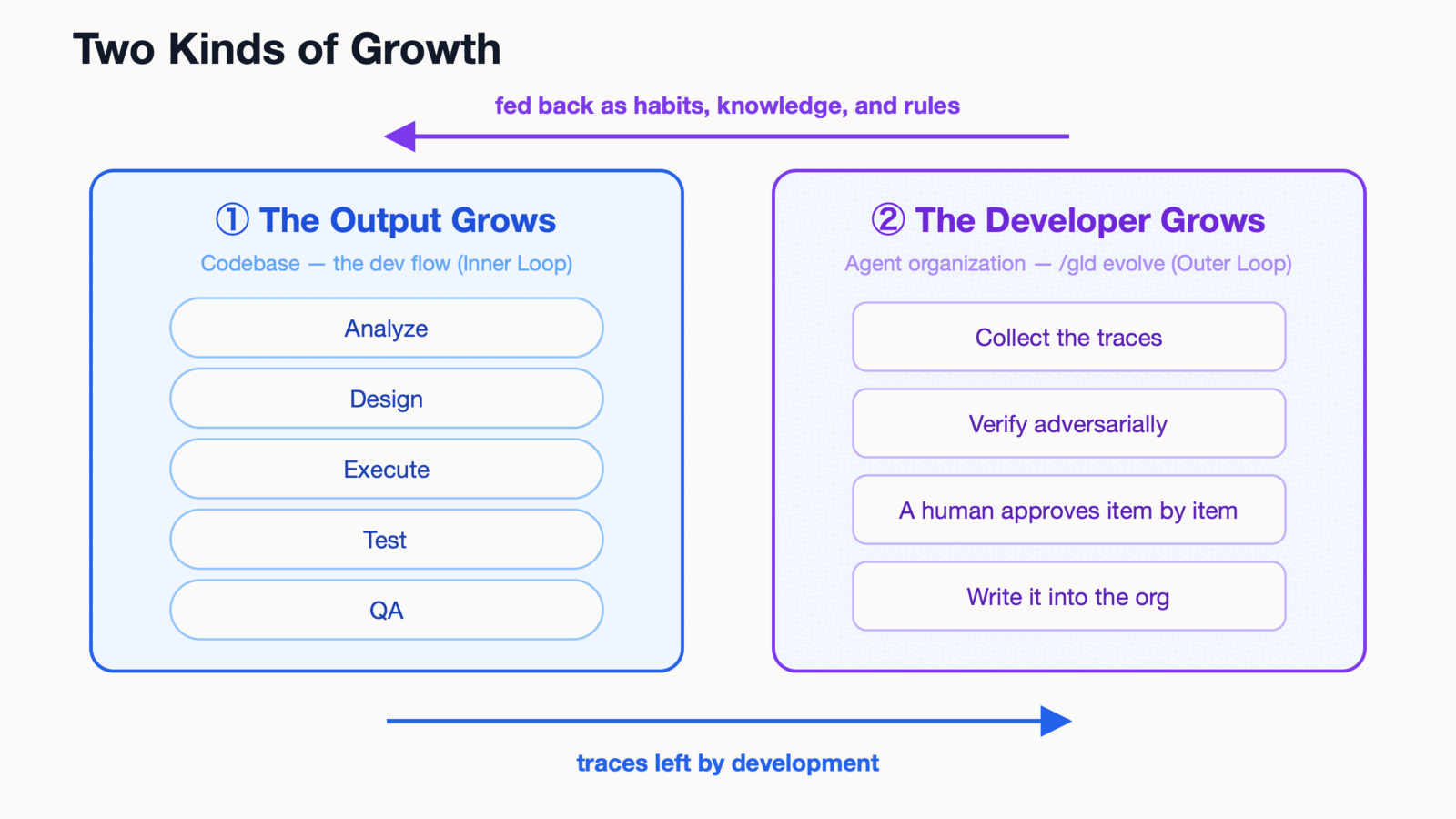
Put simply, Guild Plugin is a plugin where the codebase and the AI agents grow together.
It installs a harness — the environment in which that growth happens — and a Guild, the organization, into the repository. The codebase and the AI agents that belong to that organization then influence each other and grow.
Basic usage looks like this.
/gld init            # analyze the repo → harness + founding agents + standards (once per repo)
/gld dev 123         # take GitHub issue #123 from start to finish
/gld evolve          # grow the organization
Building an Agent Organization in the Repo
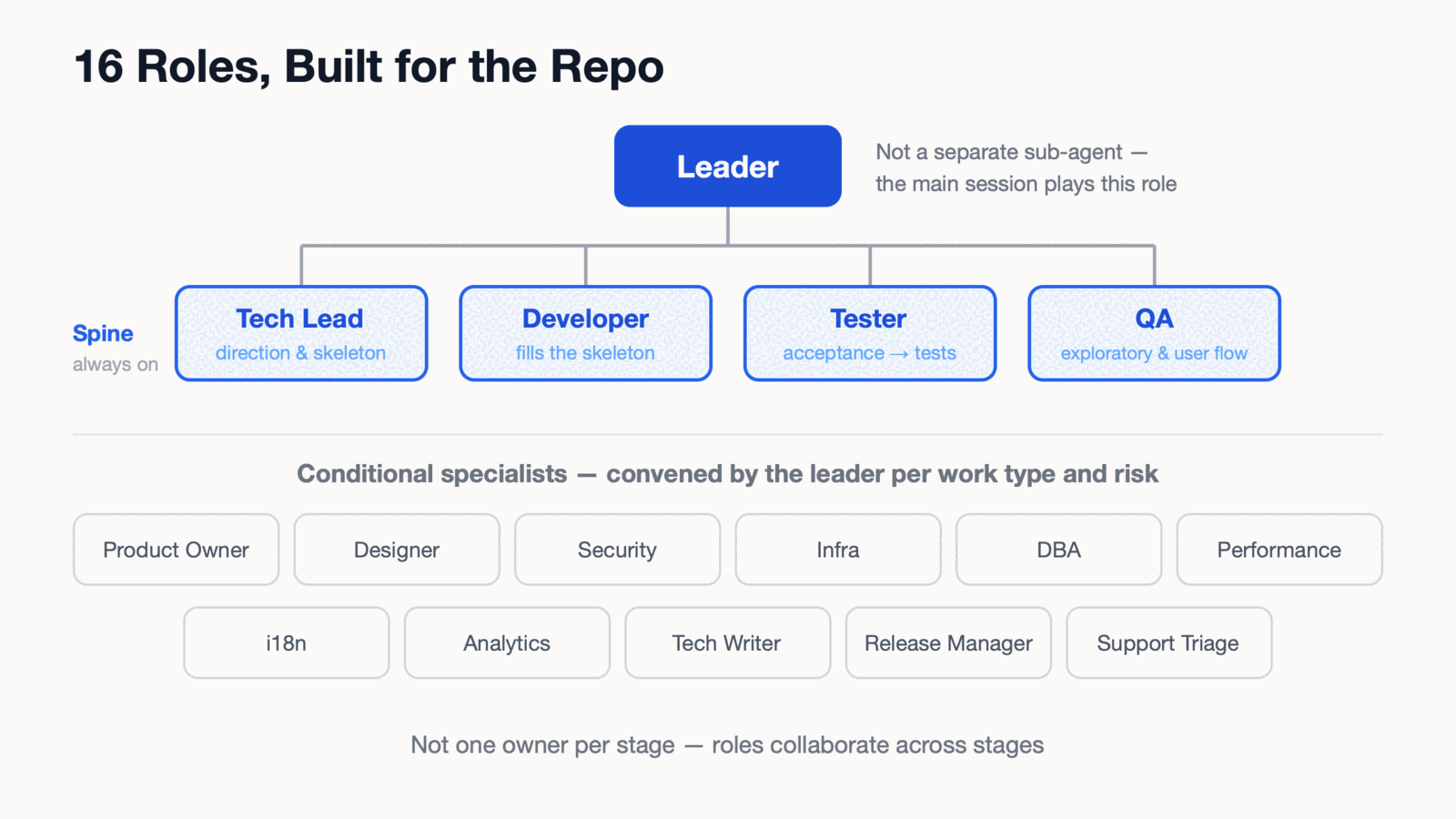
Running /gld init creates 16 base agents, tailored to that repository.
By default the leader, tech lead, developer, tester and QA walk the development process together. The remaining agents are convened by the leader whenever they are needed.
If the task involves authentication and permissions, a security specialist agent gets pulled in. If it is about UI/UX, the designer agent does. That is how the work proceeds.
This is the part that answers the general-purpose problem from SDD Plugin. Instead of calling an anonymous generic AI afresh every time, role definitions with names live on as files in the repository.
The First Growth That Raises the Codebase
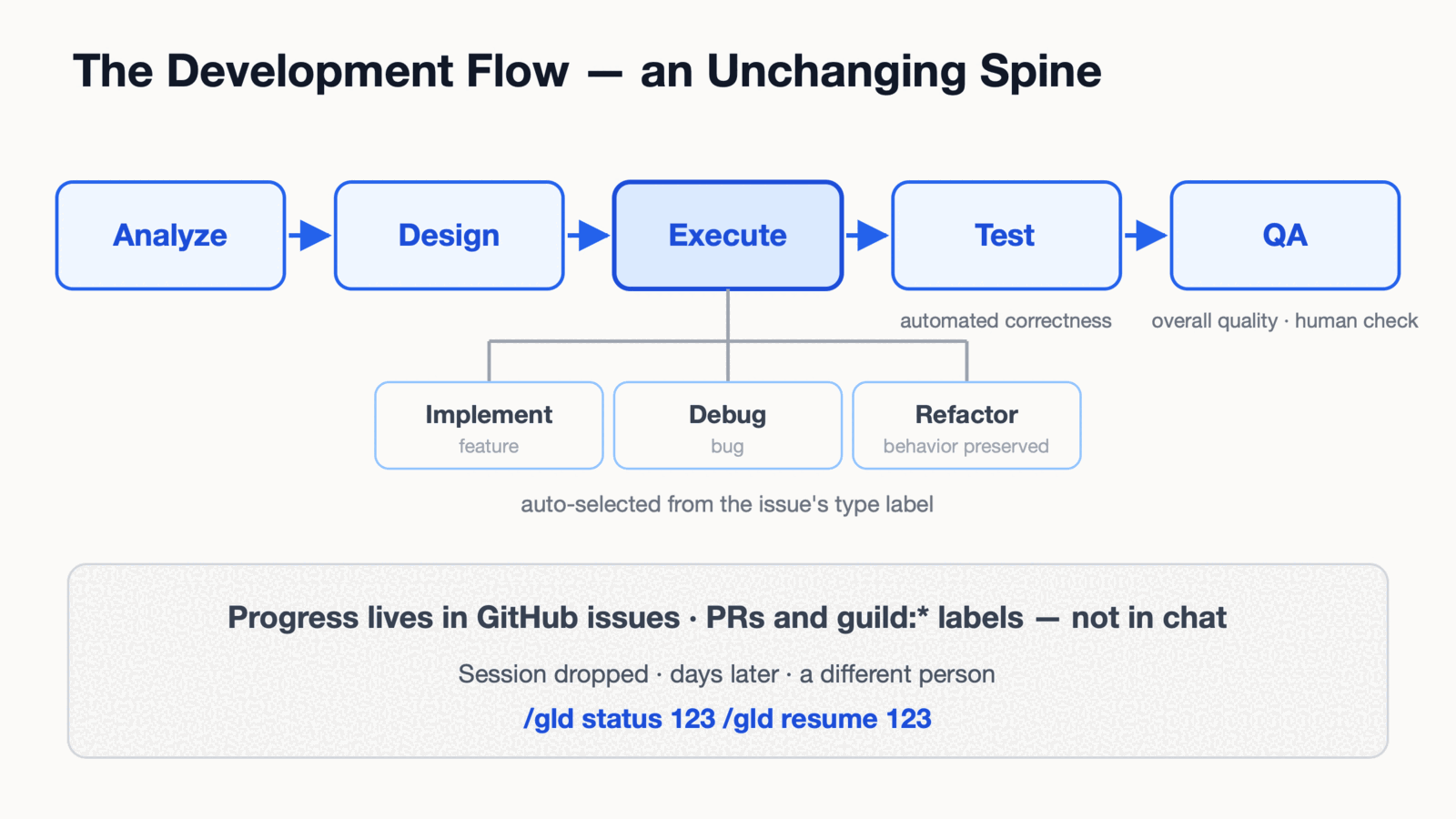
Guild Plugin uses that agent organization first to grow the codebase.
Just like SDD Plugin, it walks analyze → design → execute → test → QA, with the AI agents collaborating along the way to build the code up.
Progress lives in GitHub issues, PRs and labels rather than in the chat, so even if the session drops you can check where things stand with /gld status and pick it up again with /gld resume.
The Second Growth That Raises the Agents
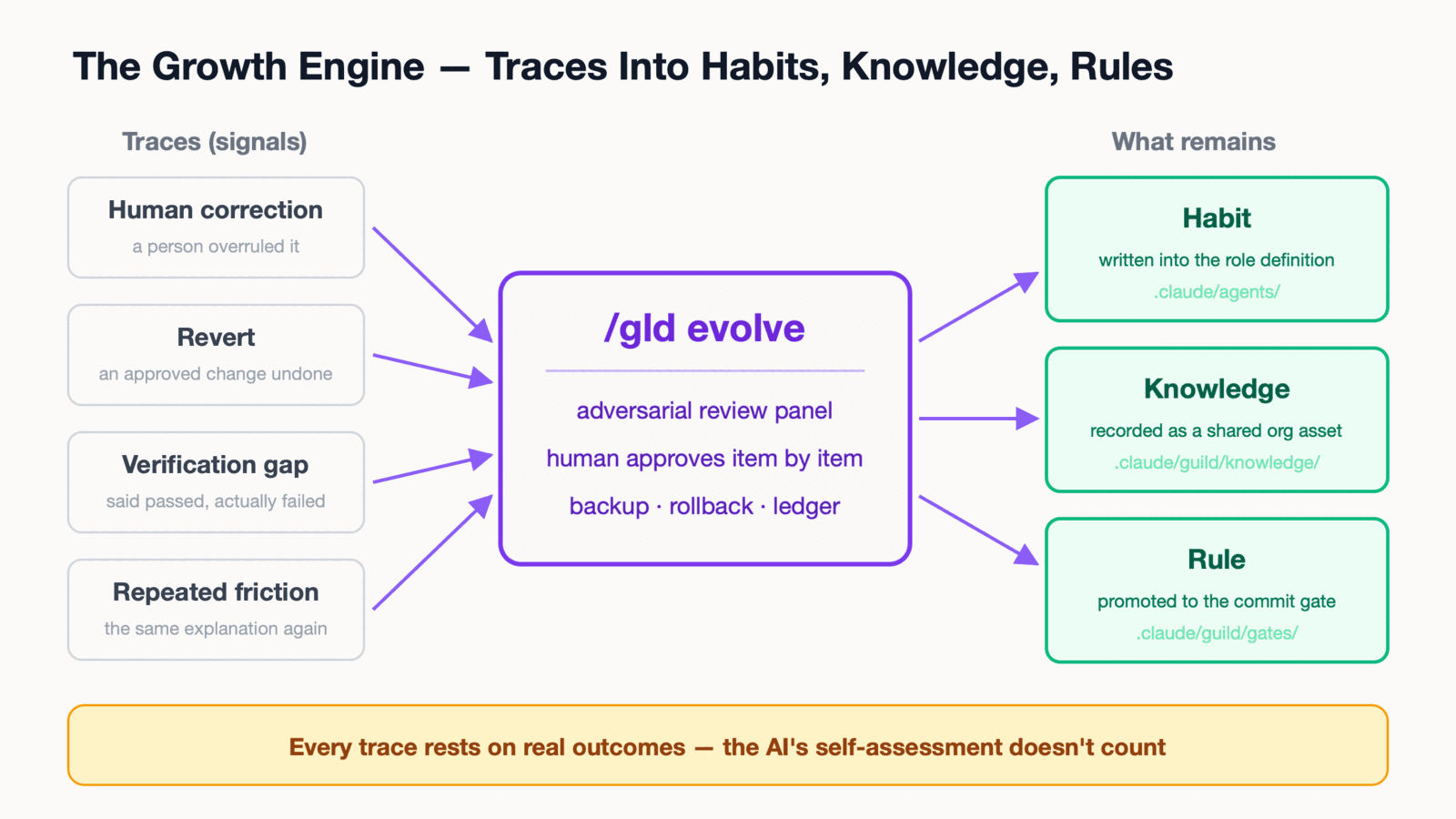
The other one is growing the developer — that is, the agents.
There is a skill called /gld evolve. Running it looks at what happened while you were developing with Guild Plugin — human corrections, reverts, verification gaps, repeated friction — and grows the agents’ habits, the organization’s knowledge, and the codebase’s rules.
- Habits are written into the agent’s file, raising what that agent is capable of.
- Knowledge is stored at the organization level — information that spans agents — somewhere the agents can consult while developing.
- Rules capture what can be flagged mechanically, so it gets flagged automatically.
There is also an HR function. When development needs expertise that none of the defined agents have, a new agent for that expertise is created. Habits and knowledge raise an agent’s quality, but when an agent still behaves oddly, that agent is deleted and a new one is created.
The Third Axis Is the Person Using the Tool
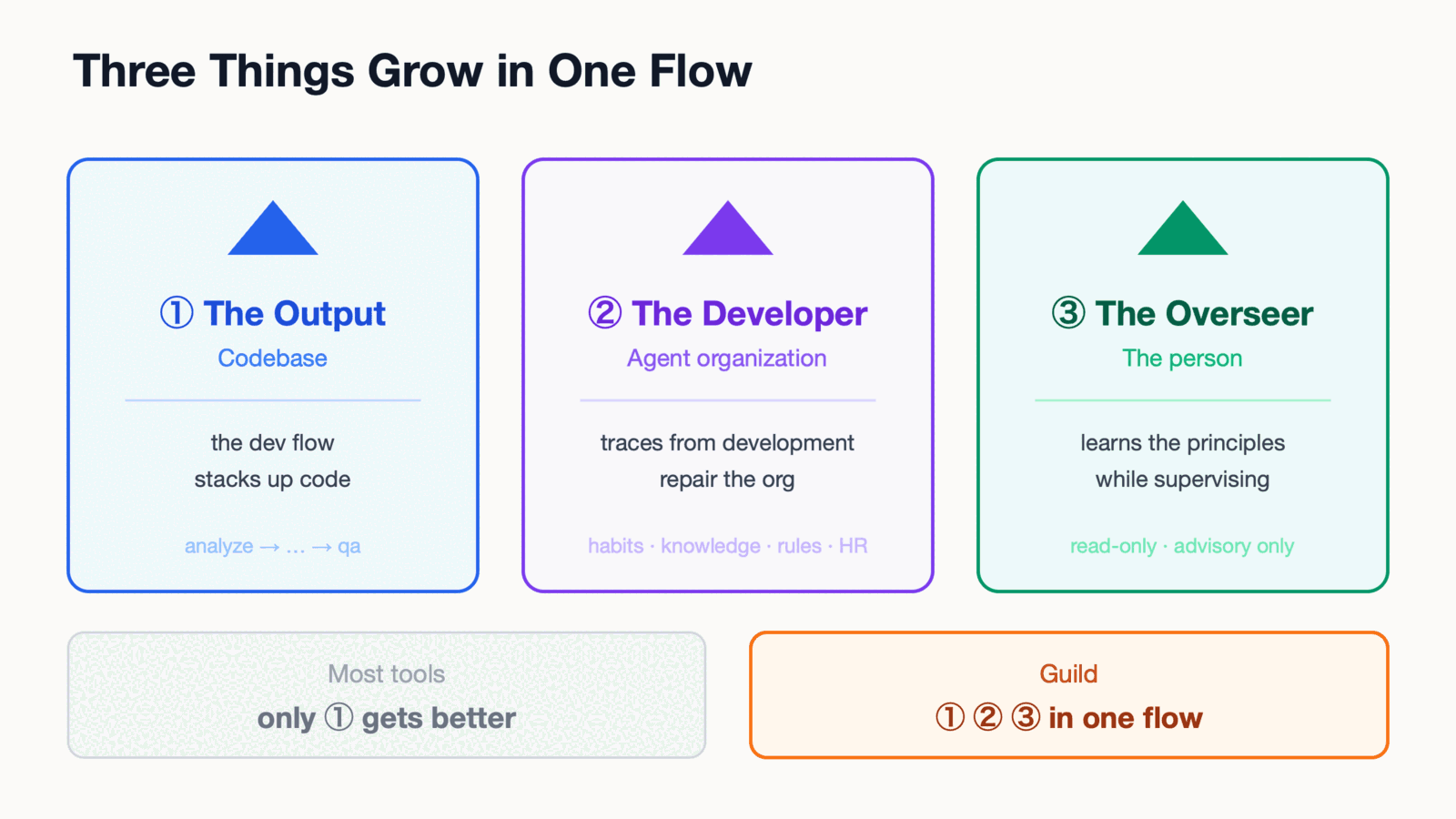
So the codebase and the agents grow together. But having built that far, I started to think the overseer using this plugin — the developer — needs to grow too.
So Guild Plugin has various mechanisms that also grow the developer who is using it.
When we develop with generative AI, I think most of us think hard about how to use AI to develop efficiently. But growing the developer who uses it doesn’t seem to get much thought, so I put that slightly unusual angle into this one as well.
Wrapping Up
Here is how I closed the talk.
The two problems I had with SDD Plugin — a tool that does not grow and an AI with no clear role — are addressed in Guild Plugin through division of labour, agent growth, team growth and an HR function. On top of that, various mechanisms try to make the person using the plugin grow as well.
Two things stuck with me from building Guild Plugin.
- To use AI well, it also matters to observe and understand how people work.
- It is not only about developing efficiently with AI — you have to think about the growth of the person using it too.
Guild Plugin is available from the deku-claude-plugins marketplace. For the full detail, see Part 1 · Part 2 · Part 3 · Part 4.
Was my blog helpful? Please leave a comment at the bottom. it will be a great help to me!
App promotion
Deku.Deku created the applications with Flutter.If you have interested, please try to download them for free.